
Playful design – making sustainability fun, full of dopamine and positive emotions
This blog series is a collaboration between Green Nudges Consulting and EVRgreen Studio, combining creative storytelling with behavioural science to drive sustainable change. Hosted on the EVRgreen Studio website, the series explores smart, human-centred nudges that make sustainable choices easier and more engaging.
Each article features examples from the Green Nudges platform: our free, public collection of real-world interventions designed to shift behaviours for the better. From gamification to subtle prompts, these nudges highlight how small design choices can unlock big impact.
This third and final blog of the series is about how we can make sustainability fun, full of dopamine and positive emotions through playful design.

🏀Making boring fun
Now imagine that same feeling sneaking into a daily routine: tossing a paper towel into the bin. In New Hampshire, USA, a recycling station was redesigned into Bathroom Basketball, with a hoop over the bin. Suddenly, a dull task turned into a quick game. People aimed, scored, and – without realizing – kept the bathroom cleaner. Surveys later showed that people not only recycled more but also reported enjoying the task, demonstrating how playful design can create lasting behavioural change!
This is the power of playful design. When sustainability feels like play, it stops being a chore. In this article, we will compare the game Cool Choices, a carbon reduction card game, with quiz formats like The Waste Game (discussed in the second blog), by the Behaviouralist, that replaces dry facts with curiosity and fun.
🚿Cool household choices
In collaboration with Cool Choices, the University of Wisconsin-Madison’s Department of Psychology implemented a game-based intervention to tackle household-level greenhouse gas emissions.
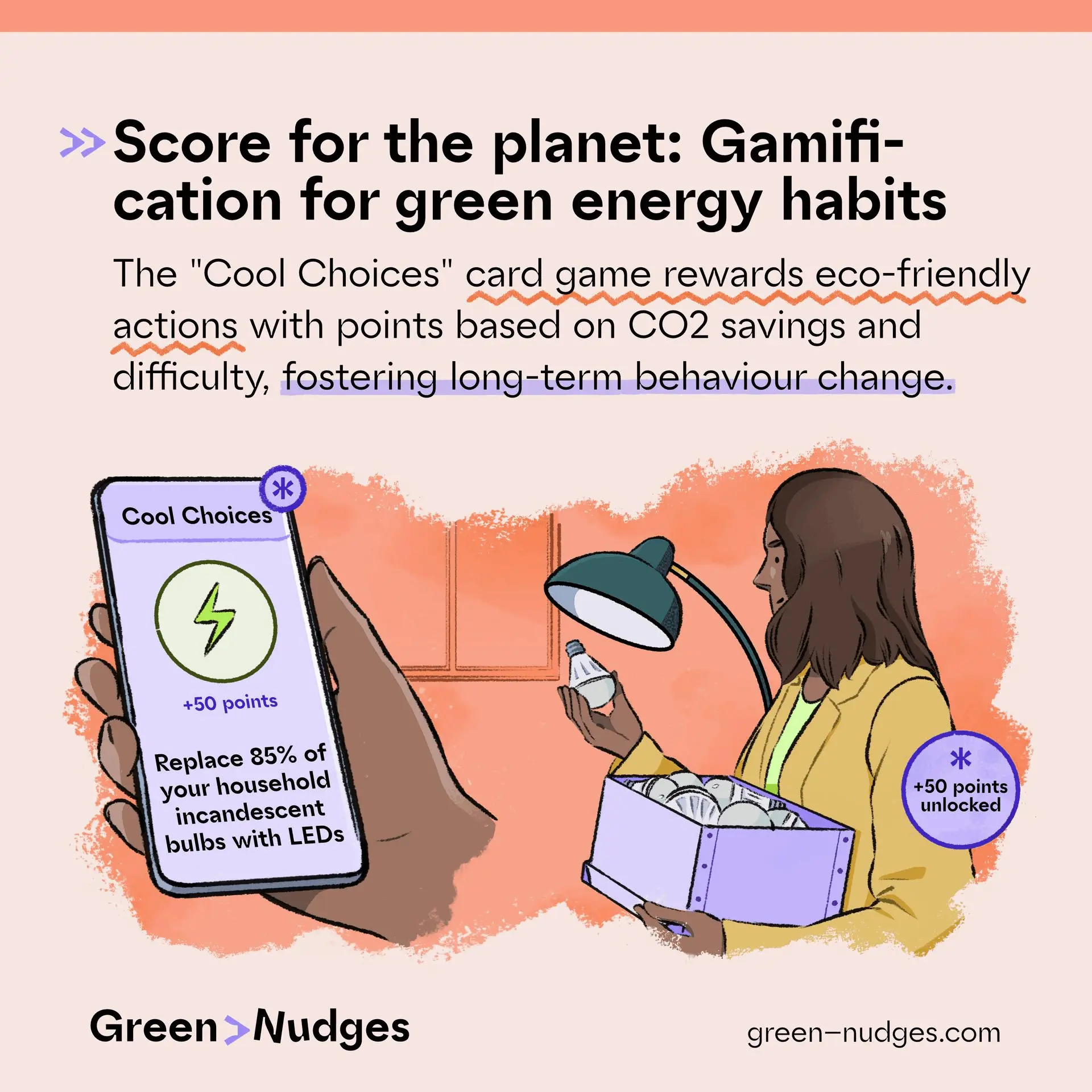
Players earn points by performing eco-friendly actions specified on cards, which are valued based on CO2 savings and difficulty. Cool Choices uses team-based challenges and instant feedback to trigger dopamine-driven motivation.

Real life actions ♻️
The Waste Game, on the other hand, is designed as a quiz, focusing on waste prevention followed by recycling. At the end of each level, players can choose to commit to a set of actions in real life before unlocking the following level. Players can earn points throughout the game and can compete against each other with a chance to win a reward based on their performance.
The Waste Game is created by The Behaviouralist. Visit their project page here:
Why does this work, and what is the psychology behind it?
⭐ Flow: engaging tasks feel effortless and absorbing. People are most motivated when a task balances challenge and skill. Playful nudges create micro-challenges that make even rather mundane actions rewarding.
🌞 Positive emotion: joy and laughter make habits easier to repeat. Positive feelings trigger dopamine release, which strengthens habit formation. When actions feel fun, people are more likely to repeat them.
🔗 Association: sustainability feels light and enjoyable, not heavy or guilt-driven. By pairing eco-friendly actions with playful experiences, people form positive connections. Over time, sustainability becomes linked to pleasure rather than obligation.
How can we implement this into our daily lives?
Add joy to everyday tasks. Whether it’s playful visuals, game-like mechanics, or light-hearted twists, fun can transform sustainability into something people actively want to do.
By tapping into dopamine, flow, and positive associations, playful design makes sustainable actions intrinsically rewarding. These interventions work best when activities are simple, feedback is immediate, and participants can experience small wins frequently.
📔Read more
This was the final blog of our series: What gamification can do for sustainability. We hope you enjoy them and that you feel inspired to implement more playful design into your life for sustainable action!
Below you can read every blog of the series:
Blog 1: Competition and comparison – how social interaction motivates us for sustainability
Blog 2: Progress and reward – how tangibility, levels, and vouchers make us do the right thing
Blog 3: Playful design – making sustainability fun, and full of dopamine and positive emotions
Gamification shows us that climate action doesn’t have to be heavy - it can be light, fun, and motivating. And when more people play along, the planet wins!
👉 What playful design would you implement in your daily life to grow sustainable actions? Drop us a line:
hello@green-nudges.com and ⬇️
We look forward to getting in touch.
Do you have questions, want to share ideas or just get to know us? We'd love to hear from you! Please contact us at info@evrgreenstudio.com, please call +31644290684 or use the contact form below.